Optimax Investment

2020 Emotional Release Process around Wealth Management

Feel what it feels like to be responsible for managing a lot of money

NeuroYou Protocol: Neurofuture
  1. Feel what you feel like right now being responsible for managing a lot of money
  2. Feel what you will feel in the future now being responsible for managing a lot of money
  3. Combine the present and future feelings together
  4. Use Neutralize on the combined feelings
COMPLETE


Insights: For me the right thing to do right now is actually spend a lot of time thinking about and neutralizing all my old money stories, use the incredible resource of our library of diverse money books to research and change beliefs, and clearly energize and imprint new beliefs and feelings about money. 


NeuroYou Protocol: NeuroPast
  1. Feel what you feel like right now being responsible for managing a lot of money
  2. Feel what it felt like in the past being responsible for managing a lot of money
  3. Combine the present and past feelings together
  4. Use Neutralize on the combined feelings
COMPLETE
Insights: Right now Sylvia and I have a unique opportunity to completely reset our money story. We have enough money through Eden2 sale and access to Sylvia's mothers money to not work for some months. This allows space to relax and recovery from the horrible year we had in 2019, and really connect with a new space of possibility, identify new opportunities, and take action that will dramtically increase our wealth in the next decade.


Insights: Emotions and beliefs experienced managing a lot of money: 
Emotions:
  • Managing a lot of money will feel calm
  • Managing a lot of money will feel clear. 
  • Managing a lot of money will feel full of possibility
Beliefs:
  • My organizational, planning, thinking and detail orientation will be exactly the skills needed
  • We will grow our assets and income every month until we choose to live only on our investment income. 
  • Our success will be clearly measurable, by seeing how our combined net worth increases every month.

2020 Wealth Management Beliefs

What rich people do.
  1. Rich people consistently spend less than they make. Poor people spend more than they make
  2. Rich people are happier saving their money. Poor people are happier spending their money.
  3. Rich people believe: “I create my life.” Poor people believe: “Life happens to me.”
  4. Rich people play the money game to win. Poor people play the money game to not lose.
  5. Rich people are committed to being rich. Poor people dream about to be rich.
  6. Rich people think big. Poor people think small.
  7. Rich people focus on finding opportunities to make money. Poor people focus on the obstacles to making money.
  8. Rich people admire other rich and successful people. Poor people resent rich and successful people. 
  9. Rich people associate with positive, successful people. Poor people associate with negative or unsuccessful people. 
  10. Rich people are willing to promote themselves and their value. Poor people think negatively about selling and promotion.
  11. Rich people are bigger than their problems. Poor people are smaller than their problems.
  12. Rich people are excellent receivers. Poor people are poor receivers.
  13. Rich people choose to get paid based on results. Poor people choose to get paid based on time.
  14. Rich people think “both”. Poor people think “either/or”.
  15. Rich people focus on their net worth. Poor people focus on their working income.
  16. Rich people manage their money well. Poor people mismanage their money.
  17. Rich people have their money work hard for them. Poor people work hard for their money.
  18. Rich people act in spite of fear. Poor people let fear stop them.
  19. Rich people constantly learn and grow. Poor people think they already know.
  20. Rich people are empowered, energized and freed by the money they have. Poor people are dis-empowered, de-energized and trapped by their lack of money.
How do I measure up

1. Rich people consistently spend less than they make. Poor people spend more than they make

What emotion do I feel when spending less than I make?
I feel responsible but boring and unexciting.

What emotion do I feel when spending more than I make?
Spending more than I make creates stress and panic.
What emotion do I want to feel when spending less than I make?
I want to feel blissful calm and safety because my bank accounts grow every single month.

2. Rich people are happier saving their money. Poor people are happier spending their money.

What emotion do I feel when I am saving money?
Saving makes me feel virtuous and like I'm being good.

What emotion do I feel when spending money?
Spending makes me feel nervous and worried.
What emotion do I want to feel when spending money
I want to feel clear, calm and excited because spending money means I am creating what I value in my life.

3. Rich people believe: “I create my life.” Poor people believe: “Life happens to me.”

What emotion do I feel when I am creating my life: 
Creating my life is hard work and I often feel alone in taking responsibility to generate new ideas, convince others to take action, and make things happen.

What emotion do I feel when life is happening to me?
I feel calm because there is nothing to do, I just need to react.

4. Rich people play the money game to win. Poor people play the money game to not lose.

My old story about playing the money game: 
"You have to have a lot of money to make money, and I'll never have enough"

My new story about playing the money game:
"I have the skill, the time, and the money to successfully invest and grow our wealth to achieve permanent financial independence"

5. Rich people are committed to being rich. Poor people dream about to be rich.

My old story about being rich: 
"I don't have the right personality to become rich. I'm just not pushy and aggressive enough"

My new story about being rich:
"I'm committed to energize every action I take to become rich"

6. Rich people think big. Poor people think small.

My old story about thinking big: 
" I'm just not pushy and aggressive enough to make big deals and get rich in business"

My new story about thinking big:
"I continually push myself to imagine the emotional experience of what it means to think big financially"

7. Rich people focus on finding opportunities to make money. Poor people focus on the obstacles to making money.

My old story about finding opportunities: 
"My family didn't come from money, so I never came into contact with people that could offer me financial opportunities"

My new story about finding opportunities:
"I'm actively feeling the space of possibility in my own consciousness. From that that space, ideas for financial opportunities occur to me effortlessly"

8. Rich people admire other rich and successful people. Poor people resent rich and successful people.

My old story about admiring other rich and successful people. 
"Rich and successful people have something I just don't have, that's why they are rich and I am not"

My new story about admiring other rich and successful people:
"I actively feeling being rich in all its detail"


9 Rich people associate with positive, successful people. Poor people associate with negative or unsuccessful people.

My old story about associating with positive, successful people. 
""

My new story about associating with positive, successful people.
"I actively feeling associating with positive people in all its detail"


Rich people are willing to promote themselves and their value. Poor people think negatively about selling and promotion.

Rich people are bigger than their problems. Poor people are smaller than their problems.

Rich people are excellent receivers. Poor people are poor receivers.

Rich people choose to get paid based on results. Poor people choose to get paid based on time.

Rich people think “both”. Poor people think “either/or”.

Rich people focus on their net worth. Poor people focus on their working income.
Rich people manage their money well. Poor people mismanage their money.
Rich people have their money work hard for them. Poor people work hard for their money.
Rich people act in spite of fear. Poor people let fear stop them.
Rich people constantly learn and grow. Poor people think they already know.
Rich people are empowered, energized and freed by the money they have. Poor people are dis-empowered, de-energized and trapped by their lack of money.

  1. I've been meticulous and focused on building net worth for the last 20 years. 
  2. I've been detail orientated and focused on financial details.
  3. I focused on a well paying salaried job in order to have money to consistently save and invest.
  4. I bought three homes and sold two, making profits on each.
  5. I bought assets using before paying taxes on my income, by saving and investing in my 401K
  6. I focused on knowing my net worth every month, so I could see what causes it to change and what financial strategies are working.
  7. I've worked on my emotions around money, investing, and being wealthy.

2019 Financial Independence Update


2015

2020 - Post Grimlinghauser Strasse Process

What is the future event that you want to work on?
I want to work on what will happen when Grimlinghauserstrasse is sold.

When I put my attention on Grimlinghauser Strasse being sold, what are my emotions?

I am feeling a mixture of relief, elation and nervousness.

The relief is because the whole process of her fathers's death, her mothers dementia has bee a huge source of stress in our lives. Too much attention has been consumed by it and fixed on it. Having the house sold will release some of that fixed attention.

The nervousness is because the responsibility of advising Sylvia how to manage the money without it simply running through her hands creates enormous pressure for me.

I know if I do not succeed in to a large extent controlling what she does with that money, she will simply spend it all within 2-3 years on promoting her business and doing more self develop course, probably without success, and neither succeed in creating income from her business, and then waste the opportunity to grow our family wealth through smart investment.

But I also fear that my own investing skills are not sufficient to grow it either.

When I put my attention on Grimlinghauser Strasse being sold, what are my beliefs?

I have a belief that money just disappears when invested. Investment fees, losses and spending mean money saved only ever gets smaller, never bigger. This is disappointing, depressing, and makes me feel hopeless and powerless. This belief persists despite the fact that I successfully grew our net worth 600% in the last decade. My observation of Sylvia over the years strengthens this belief because she has never saved a single dollar long term in the entire time we are married. She has absolutely no concept of either saving or investing, despite having a shelf full of books on money.

I have a fear that Sylvia would make money she received from her mother disappear. Sylvia can be  very persuasive and will come up with many ideas about how to 'invest' despite the reality that she has absolutely no skills at evaluating any type of investment. Resisting her ideas consumes a lot of time and attention, as it plays into my owns desires just to have miraculous financial success appear as if by magic.

What ideas and emotions do you want to place in your space of possibility, instead of these fears and beliefs.

I want to feel that Sylvia and I are able to together research and execute a wealth strategy that will ensure that the money from her parents house grows in the future securely and continuously, and this process will be successful, exciting and joyous.

Do I currently have a belief that Sylvia can change her financial habits enough to allow this to occur. 

No, I see very little so far that indicates she is acting differently. It makes me doubt the future of our marriage, when something as big as this is overwhelming for me, and takes the joy out of her receiving this unbelievable financial gift.

529 Plans for Orlando and Sebastian

Annual contribution limit for 529 plans

In 2019, many families are trying to make the most of their tax-advantaged savings accounts. Those saving for retirement may deposit up to $6,000 to an IRA or Roth IRA ($7,000 if you're over age 50) and up to $19,000 to an employer-sponsored 401(k). But what about college funds? That's where it can get tricky, since the IRS doesn't specify an annual contribution limit for 529 plans and many 529 plans offer high total contribution limits.

Most families won’t have to worry about hitting their 529 plan’s contribution limit this year, but there are some rules to be aware of if you're considering making a large deposit.

Annual gift tax exclusion

One of the many benefits of saving for a child's future college education with a 529 plan is that contributions are considered gifts for tax purposes. In 2019, gifts totaling up to $15,000 per individual will qualify for the annual gift tax exclusion, the same as in 2018 and up from $14,000 in 2017. This means if you and your spouse have three grandchildren (or children) you can jointly give $90,000 without gift-tax consequences, since each child can receive $15,000 in gifts from you and $15,000 in gifts from your spouse. Remember, the annual gift tax exclusion amount also includes non-529 gifts so be sure to include any cash or property gifts in your total.

If your total gifts to an individual will be more than $15,000 this year, the excess amount will count against your lifetime estate and gift tax exemption and will have to be reported on Form 709 when you file your taxes. In 2019 individuals can gift up to $11.4 million without having to pay federal estate or gift tax. There is no joint gift-tax return, so you and your spouse will each have to file separately.

The 5-year election

Individuals may contribute as much as $75,000 to a 529 plan in 2019 if they treat the contribution as if it were spread over a 5-year period. The 5-year election must be reported on Form 709 for each of the 5 years. For example, a $50,000 529 plan deposit in 2019 can be applied as $10,000 per year, leaving $5,000 in unused annual exclusion per year.

This is often called 5-year gift tax averaging or superfunding.

This is often a great estate-tax planning strategy for parents and grandparents. They're able to shelter a large amount of assets from estate taxes, while retaining control of the funds in the 529 account. However, if you do end up changing your mind down the road and revoking the funds in the account they will be added back to your taxable estate.


Lifetime gift tax exemption amount

Does this mean if you contribute more than $15,000 in one year or $75,000 over 5 years you'll have to pay gift tax? Not necessarily. As mentioned above, any gifts above the annual exclusion amounts will have to be reported on the federal tax Form 709, and these will be counted against the $11.4 million lifetime gift tax exclusion. Any amounts that exceed the exclusion could trigger gift taxes of up to 40%, but individuals within the $11.4 million limit will not be subject to gift taxes.

2030 Retirement Investing Strategy

Cannabis Stocks


There Are Only 9 Billion-Dollar Pot Stocks Left
Marijuana stock market caps continue to shrink.

As recently as the end of March, cannabis stocks were chugging along and handily outpacing the returns of the broader market. At one point, there were more than one dozen marijuana stocks sporting a market cap of at least $1 billion. But times have definitely changed.


Since the first quarter ended, the Horizons Marijuana Life Sciences ETF, the first-ever cannabis-focused exchange-traded fund, has lost about 56% of its value, inclusive of dividends paid, and aggregate market value losses for the entire industry look to be well in excess of $40 billion. As of the end of November, just nine pot stocks remain as billion-dollar companies, and this figure may continue to decline.


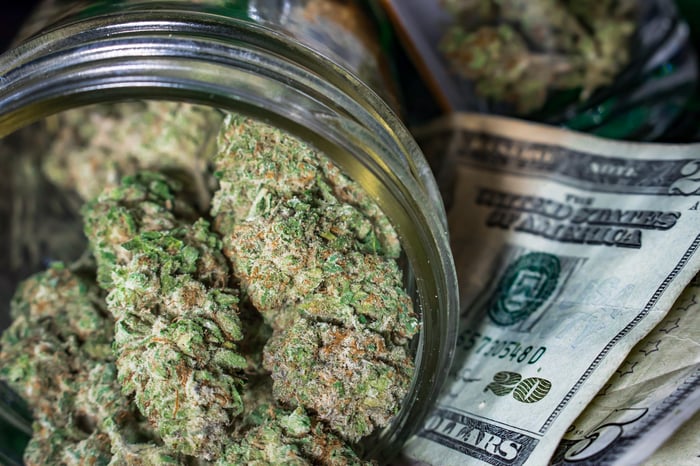
IMAGE SOURCE: GETTY IMAGES.
1. Canopy Growth: $6.48 billion

Although Canopy Growth (NYSE:CGC) easily remains the largest marijuana stock by a mile, the company has shed more than $10 billion in market cap in just a seven-month time frame. Over that span, we've witnessed Canopy Growth's share-based compensation and goodwill soar, leading to bigger losses and an ugly balance sheet. To top things off, Canopy's board fired its visionary co-CEO Bruce Linton in early July and has still yet to name a permanent successor, which sort of puts the company's long-term plans into flux. Suffice it to say that there's very real downside possibility still left in the world's largest pot stock. 

2. GW Pharmaceuticals: $3.19 billion

Even though management prefers that it not be lumped in with "marijuana stocks," GW Pharmaceuticals (NASDAQ:GWPH) now finds itself as the second-largest pot stock. GW Pharmaceuticals, which has benefited from the rapid uptake of Epidiolex and the company's ability to secure insurance coverage for its lead drug, is liable to be profitable much earlier than Wall Street had initially anticipated. Although this hasn't saved the company's share price from being beaten up in recent months, a possible label expansion for Epidiolex, or positive clinical data for any of the other cannabinoid-based drugs in GW Pharma's pipeline, should do the trick.

3. Curaleaf Holdings: $2.8 billion

The largest U.S. pot stock in the world is Curaleaf (OTC:CURLF), which chimes in with a valuation of $2.8 billion after leading all cannabis stocks to the upside in November. Curaleaf currently has more open locations (50) than any other multistate operator, and on a pro forma basis is pushing for the lead in total retail licenses held. The company has also benefited of late from the passage of the Marijuana Opportunity, Reinvestment, and Expungement (MORE) Act by the House Judiciary Committee, which could signal that the tide is turning on Capitol Hill when it comes to cannabis reform.


IMAGE SOURCE: GETTY IMAGES.
4. Aurora Cannabis: $2.64 billion

Maybe the biggest surprise on the entire list is how far Aurora Cannabis (NYSE:ACB) has fallen. Once a nearly $10 billion company that was pushing Canopy Growth for the top spot, Aurora has face-planted since mid-March, losing about three-quarters of its value. Over the past five years, Aurora has drowned its shareholders by issuing over 1 billion shares of its common stock, and it's currently lugging around an unsightly $2.4 billion in goodwill on its balance sheet. After overpaying for more than a dozen acquisitions, and with losses mounting, the most popular pot stock among millennials is finding little love of late.

5. Cronos Group: $2.36 billion

Having a lot of cash on hand isn't necessarily saving pot stocks anymore, as evidenced by Cronos Group's (NASDAQ:CRON) fall from grace. Despite sporting close to $1.5 billion in cash and short-term investments -- pretty much all of which came from a $1.8 billion equity investment from Altria Group that was completed in March -- Cronos Group continues to lose money on an operating basis, once one-time benefits are stripped from the equation. This is also a company whose outlook has taken a hit due to the vaping health scare in the United States. Cronos is no longer a sure thing to "kick bud" when derivatives hit Canadian dispensary shelves in about two weeks.
6. Tilray: $1.99 billion

Speaking of how the mighty have fallen, need I remind everyone that Tilray (NASDAQ:TLRY) moon-shot to a valuation of $26 billion just two months following its initial public offering, only to give up most of that market cap over the past year. Tilray's management team has looked lost at times, with the company de-emphasizing investments in Canada in favor of Europe and the U.S., and continuing to lose quite a bit of money on an operating basis. Tilray's purchase of hemp foods company Manitoba Harvest has added some predictability to its bottom line, but it's also been a drag on margins.


IMAGE SOURCE: GETTY IMAGES.

7. Green Thumb Industries: $1.92 billion

Other than Curaleaf, the only other billion-dollar pot stocks in the U.S. are vertically integrated multistate operator Green Thumb Industries (OTC:GTBIF) and the next company on this list. Green Thumb has been making acquisitions to move into potentially lucrative marijuana markets, such as Nevada, and is nearing 100 retail licenses owned. Further, the company has received a bit of a boost of late from discussion on the MORE Act. Even with Senate Majority Leader Mitch McConnell (R-Ky.) unlikely to bring the MORE Act to the Senate floor for vote, assuming it's passed by the House, momentum continues to push cannabis into the political spectrum.
8. Trulieve Cannabis: $1.42 billion

That "next company" is none other than Florida's Trulieve Cannabis (OTC:TCNNF). Trulieve is among the few pot stocks that's actually having a good year. The company's laser focus on the Florida market has led to the opening of 40 stores in the Sunshine State, while at the same time allowing Trulieve to keep its costs down and effectively build its brand. No pot stock is more profitable at the moment. 
 
9. Aphria: $1.2 billion

Last, but not least, Aphria (NYSE:APHA) continues to cling to its billion-dollar market cap, despite losing it very briefly in November. Aphria has benefited in recent quarters from steady results in its pharmaceutical distribution business, as well as positive fair-value adjustments from its cannabis operations. But when looking strictly at its pot business, Aphria is still losing money on an operating basis. Further, it's yet to fully regain the trust of investors following two notable transactions. It would not be a surprise if Aphria loses its billion-dollar valuation.
Newer Posts Older Posts Home
Subscribe to: Posts (Atom)

Overview

  • 2020 - 2030 Retirement Investment Plan
  • 2020 - 2030 Financial Growth Goals
  • Peter Investing
  • Peter Finances
  • Sylvia Finances
  • Sylvia Investing
  • Professional Trader
  • Trading Log
  • AIM Summary
  • AIM Trading System
  • AIM System Design
  • Continuous Trading System
  • Spice Algo
  • AIM Lumiwealth Presentation

Bank Accounts

  • ASB
  • Bank of America
  • Chase
  • Fidelity
  • Home Depot Credit Card
  • Mr Cooper
  • TD Ameritrade

Property

  • Eden2
  • Warmlands Ave
  • Jason Hartman
  • Mallorca Modern
  • Optimax Investment Plan
  • Optimax Investment Property Template

Property Opportunities

  • The Peak
  • Candice Court
  • Arroyo Vista
  • Cottages at St Cloud
  • Elevardo Road
  • Encore at Reunion Resort
  • The Villas at Vista Grande

Sylvia

  • Becker-Hill Finances 2018 - Planned
  • Becker-Hill Finances 2018

Investment Tools

  • Logify - Rental Website
  • Rentolutions - Property Management
  • Mashvisor Property Analysis

Mental Tools

  • Exponential Wealth Creation Process
  • Living in the Space of Possibility
  • NeuroFuture Protocol

Journal

  • ▼  2021 (9)
    • ▼  December (1)
      • Financial and Trading Analysis December 2021
    • ►  November (1)
    • ►  October (1)
    • ►  September (1)
    • ►  May (1)
    • ►  April (1)
    • ►  March (2)
    • ►  February (1)
  • ►  2020 (13)
    • ►  December (1)
    • ►  June (2)
    • ►  May (4)
    • ►  February (3)
    • ►  January (3)
  • ►  2019 (9)
    • ►  December (5)
    • ►  November (2)
    • ►  May (1)
    • ►  January (1)
  • ►  2018 (14)
    • ►  December (1)
    • ►  May (8)
    • ►  March (2)
    • ►  February (1)
    • ►  January (2)
  • ►  2017 (4)
    • ►  September (1)
    • ►  August (1)
    • ►  April (1)
    • ►  January (1)
  • ►  2016 (26)
    • ►  December (1)
    • ►  October (6)
    • ►  September (3)
    • ►  February (2)
    • ►  January (14)
  • ►  2015 (12)
    • ►  November (3)
    • ►  October (7)
    • ►  February (1)
    • ►  January (1)
Travel theme. Powered by Blogger.